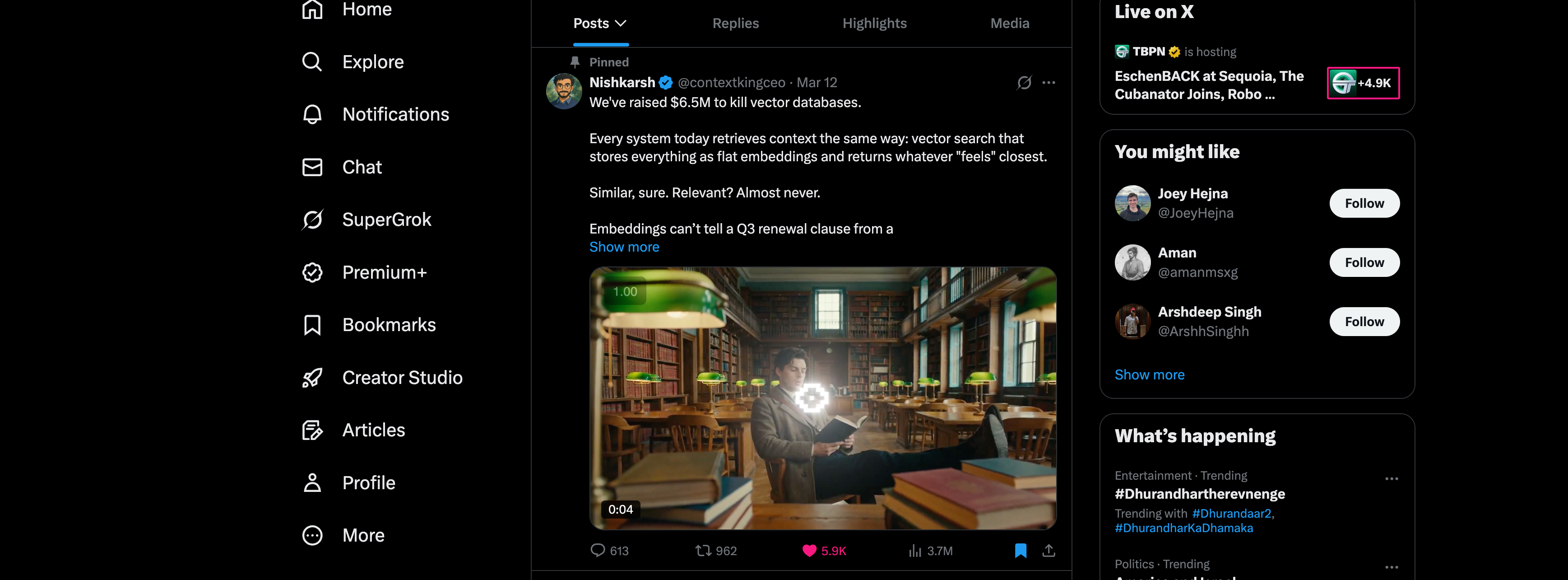
@tankots (@WisprFlow) did an announcement giving away a Porsche GT3rs on X. It hit 3.7M+ views.
@contraben(@contra) launched their payments platform and got 2.1M views.
@Replit introduced their animation feature, 7.1M views.
These are not mere coincidences. Without the strategy below, they would've done 80% worse.
At atomikgrowth.com, we've built the playbook to replicate those successes, every single time, no matter if you have 0 presence on X.
It all boils down to a science that we deploy for funding announcements and product launches. And I'm giving away every single step below.
How the X algorithm actually works for launches
X gives every post a tiny test audience in the first 30 to 60 minutes. During that window, the algorithm is measuring one thing: engagement velocity. Retweets, quote tweets, replies, likes, all relative to time.
If the ratio is high enough, the post gets pushed to a significantly larger audience. If it's not, the post dies.
Every step below is engineered to maximize engagement density in that first window.
Step 1: Make a video worth sharing
Nobody engages with a generic product demo or a plain talking-head founder video. The content itself has to do one thing in the first 3 seconds: stop the scroll.
That means showing the product doing something that looks almost unbelievable. Tanay showed that if someone broke his product, he'd give them a Porsche.
@Bouazizalex, opened with "We started about 6 years ago, struggling to even make $10K" before revealing a $300M raise at a $17.3B valuation.
The thread/video is the foundation of the entire campaign. If it doesn't stop the scroll, nothing downstream matters. No amount of influencer coordination will save a boring post.

Porsche 911 in the background = strong visual hook
Step 2: Find influencers whose audiences are your actual buyers
The standard approach is to get 50 random tech accounts to repost and call it a day. The reach looks fine on paper but doesn't convert because the audience composition is wrong.
What matters is whether the influencer's audience overlaps with your target buyers. If you're launching a devtool, you want influencers followed by CTOs and engineering leads at your target companies. Not random accounts with 100K followers who happen to post about tech developments 10x a day.
We go a step further. We identify influencers who are already followed by a company's actual customers or their peers. Our influencers are followed by Marc Andreessen, Chamath Palihapitiya, Elad Gill, Elon Musk, and Keith Rabois. When those people see your launch through someone they already trust, it carries weight.

Step 3: Verify before you deploy
Before working with any influencer, you need to verify their audience composition.
Minimum benchmark: 33% of their followers should be in your target market.
A large number of tech accounts look impressive on the surface but their followers are mostly bots or audiences in markets that are completely irrelevant for your launch. An account with 50k verified, relevant followers will outperform one with 500K followers in the wrong geography every time.
Step 4: Write custom copy for every single person
This is a very important step if you want your campaign to look & feel organic.
Every influencer gets their own personalized copy. Matched to their tone and writing style. If someone writes long and thoughtful, we match that. If someone does short punchy takes, we match that.
All copy is written by our in-house copywriters, assisted with Claude. But they're never templated. The client pre-approves every piece before it goes live.
The moment two influencers post something that reads similarly, the campaign can lose credibility.
Step 5: Build promo kits for your founder's inner circle
Every founder has 15 to 20 people who would reshare their launch. Investors. Fellow founders. Friends. Teammates. Their families.
The problem: they're busy. They don't know what to write. So they either don't post or they write something generic like "congrats to the team."
The fix:
Write a custom post for each person, from their perspective.
Investor? Write it as someone sharing why they backed you. Fellow founder? Write it as a peer endorsing the product. Existing customer? Write it from their perspective about how they actually use the product, so it reads like a genuine endorsement, not a favor.
Make it so easy that all they do is copy, paste, post. You'll be surprised how many people do it when the friction is zero.
Step 6: Structure the comment section
The comment section under your main post is prime real estate. The algorithm shows top comments to everyone who sees the post.
If those comments are empty or low quality, you're wasting it.
Have 2 to 3 larger influencer accounts start discussion threads in the comments. Then have smaller accounts reply to those threads with pre-written takes that guide the narrative deeper.
This does two things.
First, it makes the comment section look alive and high-signal. The algorithm sees engagement density and pushes the post further.
Second, it controls the narrative. The first things people see when they click into your post are intelligent, on-topic discussions. They then stay for longer.
Step 7: Improve your hook
What makes someone stop scrolling in the first 3 seconds follows the same principles that work in short-form content.

Launch videos on X are becoming increasingly more mass appeal, and the hooks that drive millions of views share the same DNA.
Crazy big numbers. Lead with a number that makes people do a double take. Revenue, valuation, growth rate, users. Be specific and flex, albeit distasteful at times.
Shock factor. Say or show something that breaks expectations. Can be visual or verbal.
Challenges. Publicly challenge your audience to break your product, or something alike.
Celebrities. Feature a recognizable face or name. Doesn't need to be mainstream famous. Think of signing the term sheet with your lead tier 1 GP.
Revolutionary acclaim. Position the product as a category-defining moment.
Step 8: Have a clear CTA
Ask people to comment a keyword in exchange for free credits, early access, or more info. This converts viewers into users on the spot and floods the comment section with engagement, which the algorithm rewards.
Step 9: Coordinate everything to hit in the same window
This is the most important step and the one most people fumble.
Everything (quote tweets, comment threads, promo kit reshares, customer endorsements) needs to land within the same 2 to 3 hour window.
20 to 30 posts hitting in the same window is what creates the sense that "everyone is talking about this." That's what triggers the algorithm to treat it as a moment. Our launches hit X's Today's News in under 2 hours.
Best time: mid-morning US Eastern.
Step 10: Track everything
Every impression from every influencer. Every comment. Every repost. Every quote tweet. Track it all.

You should know exactly which influencer drove how many views. Which angle performed best. Which comment threads generated the most engagement.
Track everything
A note on LinkedIn
People always ask about cross-posting the launch video to LinkedIn.
LinkedIn impressions are wildly unpredictable. A video can do 100K views one day and 10K the next.
The only thing that consistently works is a genuinely engaging video that stands on its own.
If you have that, try it. If not, don't split your energy. Go full throttle on X. LinkedIn is a bonus.
The short version
Make a video that hooks in 3 seconds.
Find influencers whose audiences are your actual buyers.
Write custom copy for every person in their voice.
Build promo kits for your founder's network and customers.
Structure the comment section.
Time everything to hit in the same 2 to 3 hour window.
Track every data point.
That's how to win X.
That's how funding announcements go from 500 views to millions.